Changelog

Product updates, new features, and announcements.

Managed Phaset: Self-Hosted Power, Zero Operational Burden

Your software catalog shouldn't require infrastructure expertise to run. Managed Phaset delivers the complete Phaset experience—fully hosted, maintained, and monitored—so you can focus on understanding your software landscape, not managing servers.

A New Way to Run Phaset

Self-hosting Phaset gives you complete control and ownership. It's powerful, cost-effective, and keeps your data entirely in your infrastructure. But not every team has the resources, time, or desire to manage hosting infrastructure—even when it's as simple as Phaset.

Managed Phaset removes that friction. We handle everything: infrastructure provisioning, automated backups, security patches, version updates, and monitoring. You get a dedicated Phaset instance with 99.0% uptime SLA, running on secure EU-based infrastructure. Your data stays private and isolated—just like self-hosting, but without the operational overhead.

Why Choose Managed Phaset?

  • Start immediately—no infrastructure setup, configuration, or deployment pipelines to build
  • Zero maintenance burden—we handle updates, backups, security patches, and monitoring
  • 99.0% uptime SLA—guaranteed availability with professional monitoring and incident response
  • Predictable costs—$300/month with annual discounts, versus hiring DevOps time to manage self-hosted infrastructure
  • Plus license included—get priority support, roadmap influence, and early access to features while you subscribe
  • Your data stays private—dedicated instance on EU infrastructure, not a multi-tenant shared platform
  • Same privacy guarantees—we never see your operational data, just like self-hosting

Managed vs Self-Hosted: Both Excellent Choices

Self-hosting remains the most cost-effective option long-term. A $249-$499 one-time perpetual license means you own Phaset forever—no recurring costs, complete infrastructure control, and the flexibility to run it anywhere. For teams with existing infrastructure and DevOps capacity, self-hosting is unbeatable value.

Managed Phaset is ideal when you want the power of a self-hosted solution without the operational commitment. Teams that value immediate deployment, guaranteed uptime, and professional maintenance choose Managed Phaset. You get the same feature set, the same data privacy, and the same flexibility—we just handle the infrastructure.

Pricing That Makes Sense

At $300/month (or $3,200/year with annual billing), Managed Phaset costs a fraction of what you'd pay for enterprise SaaS alternatives. Consider the comparison:

  • Cortex: ~$78,000/year for 100 developers at $65/user/month
  • Swarmia: ~€47,000/year for 100 developers at €39/user/month
  • Managed Phaset: $3,200/year flat rate (annual billing), regardless of team size

You get enterprise-grade software catalog, health scores, DORA metrics, and compliance tracking—without per-user costs spiraling as your team grows. No negotiating enterprise contracts, no hidden fees, no surprises.

What's Included

Managed Phaset includes everything from the Plus plan—the full feature set with priority support, roadmap influence, and early access to new capabilities. Plus:

  • Dedicated Phaset instance on EU-based infrastructure
  • Automated daily backups with point-in-time recovery
  • Security monitoring and automated patching
  • Version updates managed for you (you control the timing)
  • 99.0% uptime SLA with professional incident response
  • Email support with 48-hour response time

The Plus license is included while you subscribe—it's valid for running your managed instance and accessing support, but doesn't transfer to self-hosted deployments after subscription ends. If you later want to self-host, you can export your data and purchase a perpetual license separately.

The result is choice without compromise. Self-host with perpetual licenses for maximum control and long-term value. Choose Managed Phaset for immediate deployment and zero maintenance. Both options give you the same powerful software catalog, the same data privacy, and the same commitment to your success. View pricing details or read the full managed service agreement.

Facets & Coupling: Custom Metamodeling Meets Relationship Intelligence

Your software catalog just became even more flexible and insightful. Model your organization's unique architectural concepts with Facets, then visualize how everything connects with the new Coupling view—two features that work together to give you unprecedented clarity on your system landscape.

Facets: Freeform Metamodeling

Every organization has its own way of thinking about architecture. Business capabilities, value streams, technology stacks, cost centers—concepts that matter to you but don't fit into traditional catalog taxonomies. Facets change that.

Use simple tag syntax to define any metamodel concept you need. Tag a system with capability:payment-processing or business-area:customer-onboarding, and Phaset automatically recognizes the left side as a Facet—a first-class organizational dimension.

  • Zero configuration required—just start tagging with facet_name:value syntax
  • Automatic discovery—Facets appear instantly on the dedicated Facets page
  • Catalog filtering—use discovered Facets to filter and find related records
  • Organization-specific modeling—represent capabilities, business areas, named tech stacks, or any concept that matters to your architecture

Facets let you add the metamodel your organization actually uses without forcing your thinking into predefined boxes. Model what matters, discover what exists, filter by what you need.

Coupling View: Relationship Intelligence

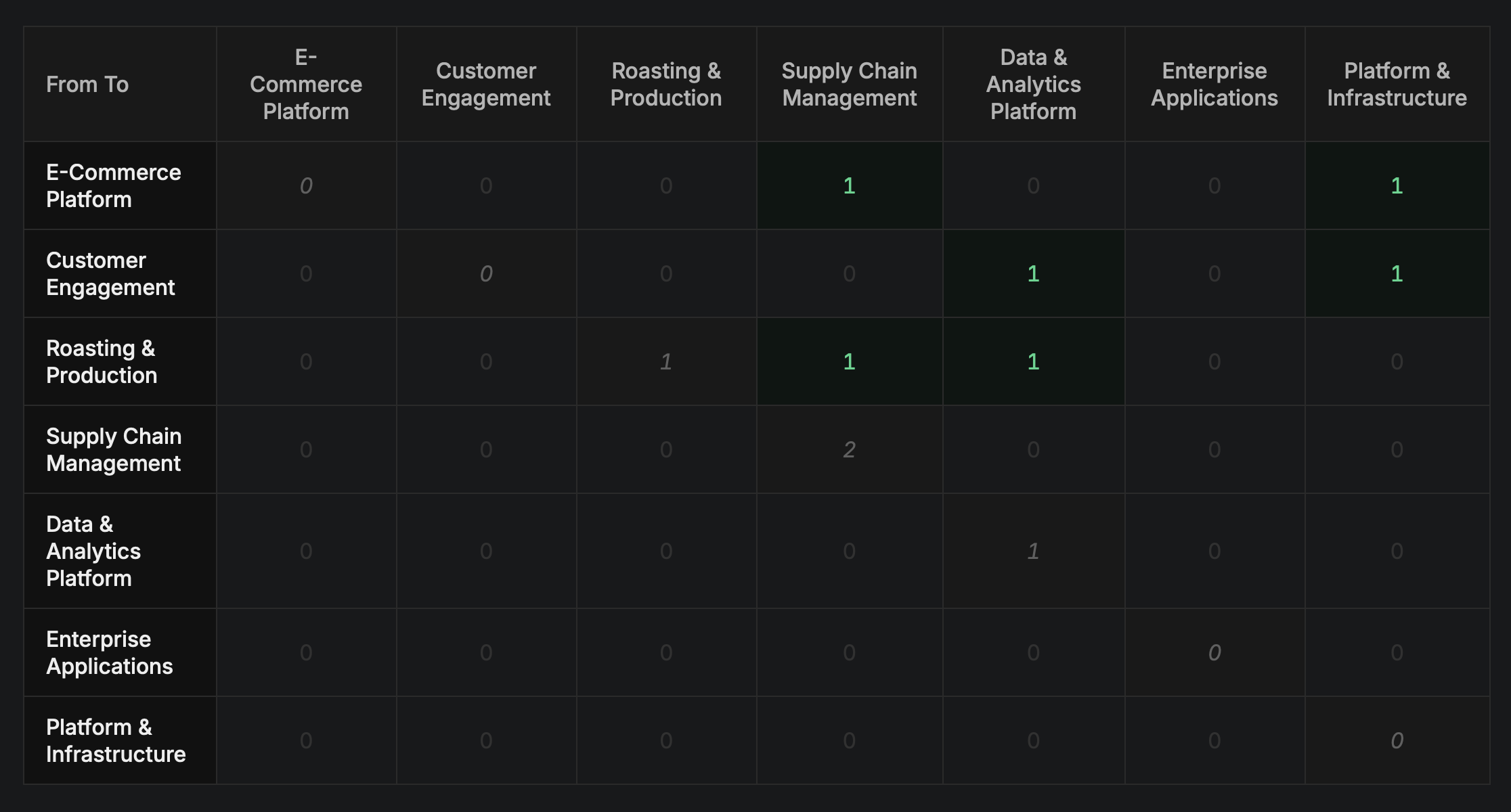
Understanding your architecture means understanding how things connect. The new Coupling view gives you a high-level perspective on relationships between Domains, Systems, and—when you use Facets—any organizational concepts you've defined.

  • Domain and System relationships—see how your architectural boundaries interact
  • Facet relationships—visualize connections between custom metamodel concepts
  • High-level clarity—understand coupling without drowning in implementation details
  • Strategic insight—identify architectural patterns, dependencies, and potential concerns

Coupling shows you the relationships that shape your architecture. Which domains are most connected? How do business capabilities map to systems? What dependencies exist between your organizational concepts? Now you can see it at a glance.

Seeing the coupling between systems

Get a direct view of coupling across Domains, Systems, and your Facets

The result is a catalog that truly reflects how your organization thinks about software. Facets let you model your world your way. Coupling shows you how it all fits together. Use them independently or combine them for maximum insight. Both features are available now in Phaset 1.4.0.

Enterprise Authentication: SSO & SCIM Support

Enterprise teams can now seamlessly integrate Phaset with their existing identity management infrastructure. Single Sign-On and automated user provisioning eliminate manual account management while maintaining security and compliance standards.

Single Sign-On (OIDC)

Enable frictionless authentication through your organization's identity provider. SSO integration lets your teams access Phaset using the same credentials they use everywhere else—no new passwords to remember, no separate accounts to manage.

  • Google Workspace and Microsoft Azure AD support—works with your existing setup
  • Zero password fatigue—users authenticate once through their familiar login flow
  • Enhanced security—leverage your IdP's MFA, conditional access, and audit trails
  • Centralized control—manage Phaset access through your identity platform

Whether you're on Google Workspace or Microsoft 365, configuration takes minutes. Point Phaset at your identity provider, and your teams can start signing in immediately.

Learn about SSO configuration →

SCIM User Provisioning

Automate the entire user lifecycle with SCIM 2.0 support. When you add users to Phaset in your identity provider, they're automatically provisioned. When someone leaves or changes roles, access updates instantly—no manual intervention required.

  • Automatic user sync—new hires get access without admin action
  • Real-time deprovisioning—offboarding revokes access immediately
  • Attribute synchronization—names, emails, and status stay current automatically
  • Verified with Azure Entra ID—tested with Microsoft's identity platform

SCIM support has been verified with Azure Entra ID (formerly Azure AD) but follows the standard SCIM 2.0 protocol, making it compatible with any compliant identity provider.

Learn about SCIM provisioning →

The result is enterprise-grade identity management without the complexity. These features extend Phaset's existing user management capabilities, giving enterprise teams the conventional, secure authentication workflows they expect. SSO and SCIM support are available now in Phaset 1.3.0.

This type of support is often critical for larger organizations. Find any bugs or issues with Phaset's support? Let me know!

Zero-Friction Onboarding: From Idea to Catalog in Minutes

There are no more barriers between you and a working software catalog. Whether you're migrating from Backstage, starting fresh, or already have Phaset records—getting to value now takes minutes, not weeks.

Instant Backstage Migration

Moving from Backstage? Phaset makes it trivial. Convert your entire catalog with the new online tool and CLI package—no manual rewriting, no data loss, no waiting.

  • Online converter for quick validation and single-file conversions
  • CLI & Node.js package for bulk migrations of entire catalogs
  • Smart mapping preserves your metadata, tags, links, and dependencies
  • Instant feedback with warnings and unmapped field detection

Paste your YAML, get compliant JSON. Convert hundreds of entities in seconds. Start exploring your catalog the same day.

Try the Backstage migration tool →

AI-Powered Manifest Generation

No existing catalog? No problem. Point Claude at your codebase and let AI do the heavy lifting. Using the new Phaset Model Context Protocol (MCP) server, Claude analyzes your code, configs, and docs to generate production-ready manifests.

  • Zero manual data entry—Claude reads your actual code
  • Works with any language—Python, Go, TypeScript, Java, Rust, whatever language that floats your boat and that Claude understands
  • Confidence scoring shows which fields need your review
  • 100% schema compliant—guaranteed to work with Phaset

Install the MCP server in Claude Desktop, Code, or CLI. Ask Claude to generate a manifest. Review, import, done.

Learn about AI manifest generation →

Seamless Record Import in Phaset

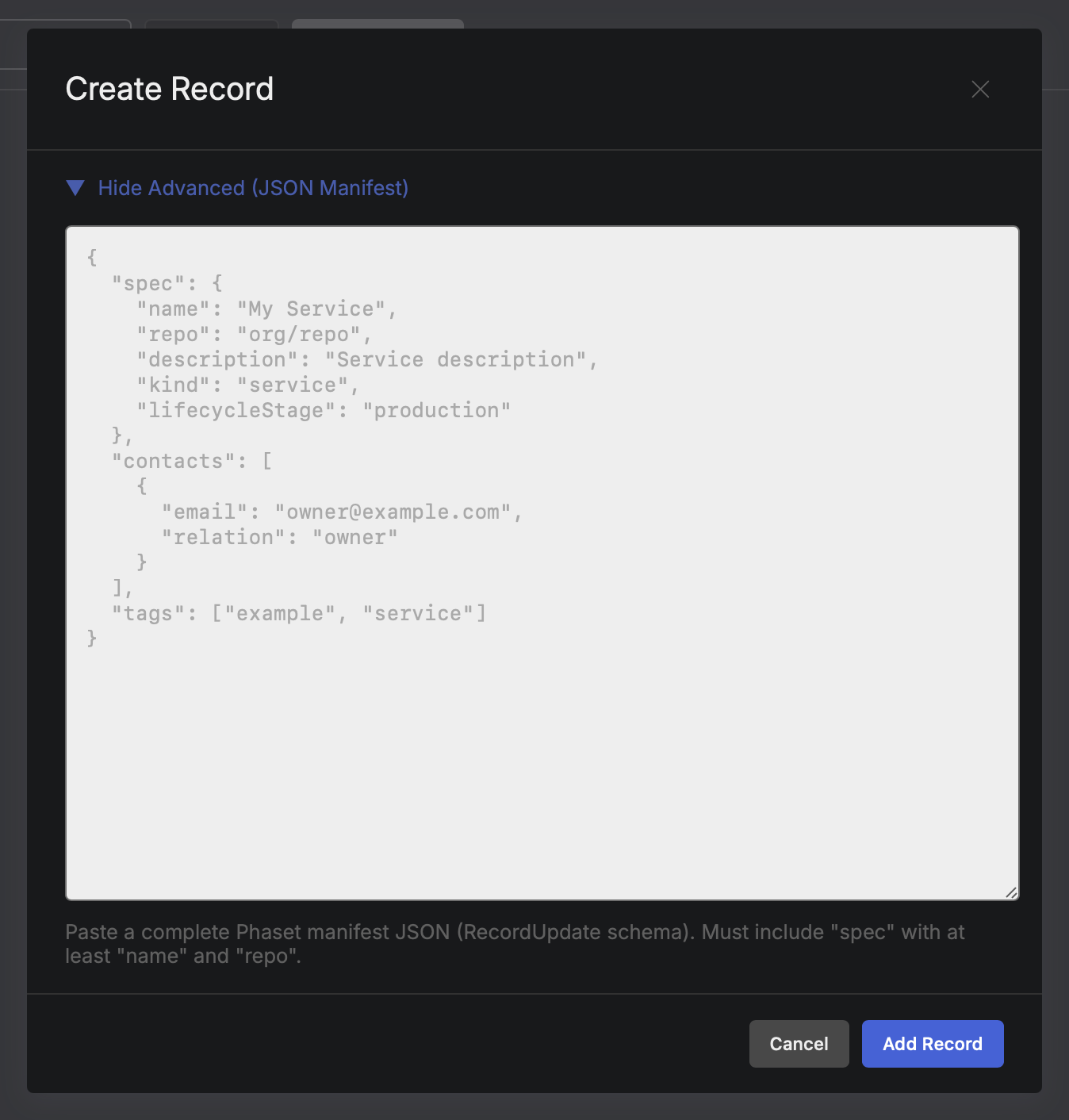
Got manifests? Importing them is now effortless. Phaset includes integrated support for uploading and validating records directly in the UI—whether they're fresh from the online converter, AI-generated, or hand-crafted.

  • Text-based import for directly populating records from your data
  • Real-time validation catches issues before they hit your catalog

Just copy-paste your manifest contents and watch your catalog come to life.

Creating records in Phaset using JSON data

Import records effortlessly with built-in validation

The result is time-to-value measured in minutes. Convert your existing catalog, generate new manifests with AI, or import what you already have—all without friction. These features are available now in Phaset 1.2.0 and online as per links.

Team Enablement: Organization Access Tokens & Self-Signup

Two powerful features that give your teams more autonomy and unlock new integration possibilities.

Organization Access Tokens

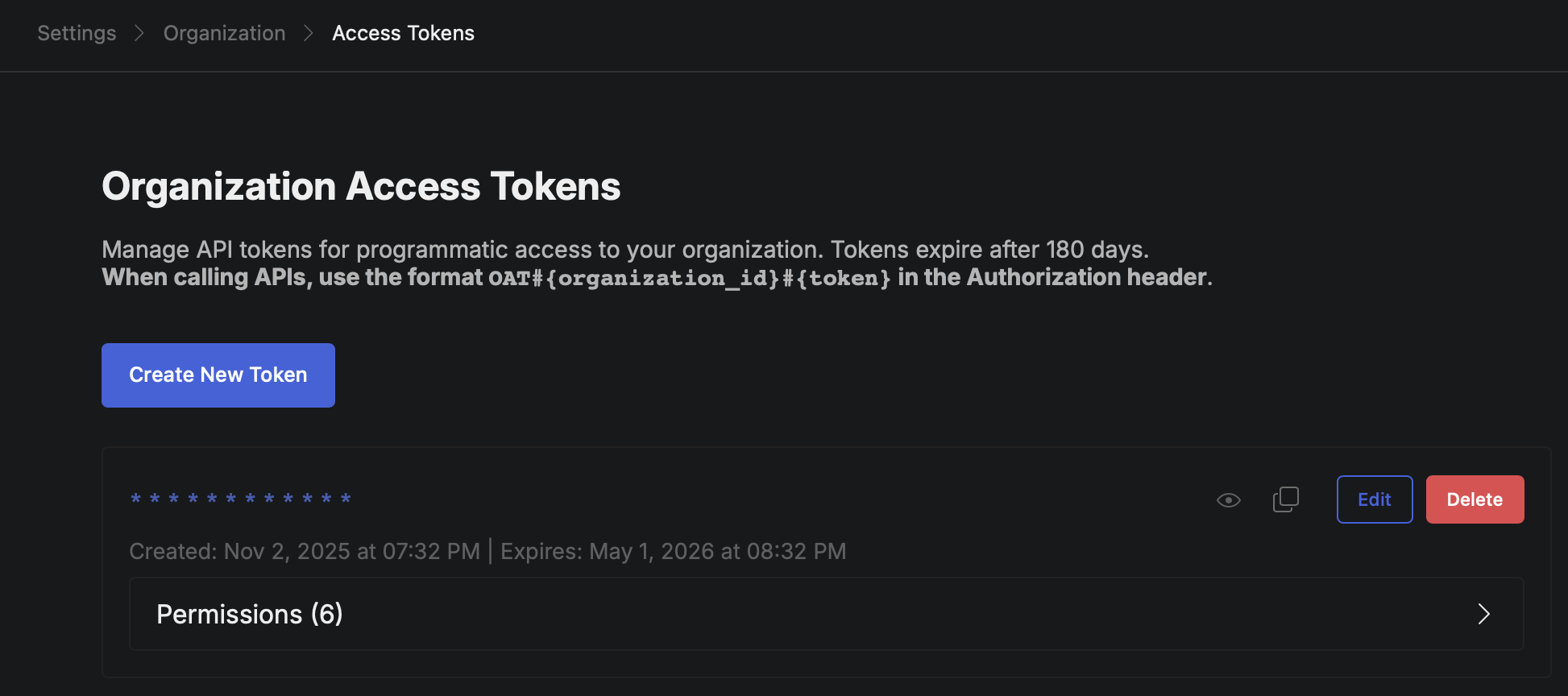
Enable programmatic access to your Phaset instance without tying integrations to individual user accounts. Organization Access Tokens give you the flexibility to:

  • Build CI/CD integrations that makes automation expand beyond just records
  • Create custom automation without depending on personal credentials
  • Manage access centrally with granular, org-level permissions
  • Scale your workflows as your team and integrations grow

Perfect for teams automating their software catalog updates, building custom dashboards, or integrating Phaset into their existing engineering workflows.

Learn more about Organization Access Tokens →
Organization Access Tokens interface showing token management and permissions

Manage organization-wide API access with fine-grained token controls

Self-Signup for Users

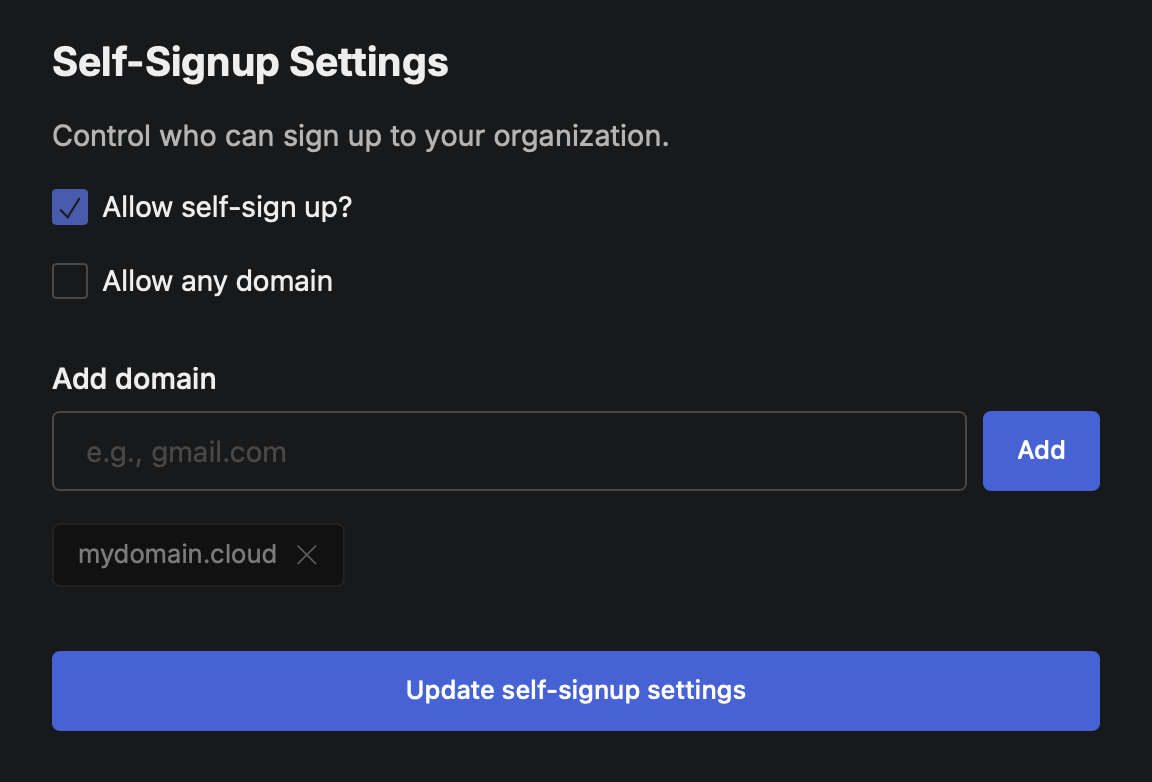
Reduce friction and empower your teams to get started faster. Self-signup lets users join your Phaset instance directly, giving you control over how open or structured onboarding should be:

  • Streamline onboarding by letting new team members register themselves
  • Reduce admin overhead with automatic user provisioning
  • Maintain control with configurable signup policies
  • Foster adoption by removing barriers to entry

Ideal for growing engineering organizations that want to democratize access to their software catalog while maintaining security and governance.

Learn more about Self-Signup →
Self-signup interface showing user registration and approval flow

Enable teams to self-register with configurable approval workflows

Both features are already available in version 1.1.0 of Phaset. Check out the documentation links above for everything you need to get started.

Stay Updated

Want to be notified about new features and updates? Join the Phaset community or follow the documentation.